Right now, a spreadsheet nobody designed is deciding what your business is worth. You cannot see what it is costing you. The competitors who can are building a lead you will not be able to buy back. 42 years. Four technology transitions. One decision: architect your intelligence, or forfeit your business.
Carl J. Peterlin, Jr. · Strategic AI Intelligence Architect™ · 42 years, Fortune 10 to startup
The most celebrated productivity tool in business history became load-bearing infrastructure no one designed, audited, or governed. AI is about to make that negligence catastrophic.
The pattern has repeated with precision across every major technology transition in modern business history. AI is the fourth, and the most brutal. The businesses asking the architectural question right now are compounding an advantage that late adopters cannot purchase after the fact.
Of AI users are bringing their own AI tools to work, feeding company data into ungoverned external systems. At small and mid-size companies the rate runs to 80%.
Corporate data flowing into AI tools rose 485% in a single year. More than one in three pieces of that data is sensitive: source code, customer records, financial forecasts.
Field audits of real-world spreadsheets found errors in 88%. When the builders were asked to estimate their own error rate, the average answer was 18%. "It works" is an 18% guess on an 88% reality.
A single unvetted formula divided by the wrong thing, silently, inside JPMorgan's own risk alarm. The bank's investigators could not determine when the error began. Same mechanism. Your scale.
Every interaction your revenue system touches generates intelligence. Every prospect engagement, every behavioral signal, every proposal opened. All of it produces data as a natural byproduct of operation.
In the spreadsheet ecosystem, that data gets vented into the air. Filed. Siloed. Contradicted. Lost. The advantage the spreadsheet was always pretending to build never compounds, because nothing was ever designed to catch it.
"Somewhere in your operation, there is a file that knows something your financial statements do not. It knows which customer is thirty days slower to pay than they were eighteen months ago. It knows which product line is quietly compressing your margin. It knows, and it is not telling anyone, because it was never designed to."
Death To Excel!, Chapter 172% of your sales team's available time is consumed by administrative burden that has nothing to do with selling. Salesforce surveyed 7,700 sales professionals to reach that number, and the documented human tendency to under-report inefficiency to outside researchers suggests the real figure in your building runs higher still.
Applied against an average rep value of $137,500, that is $108,000 in direct waste per rep every year. That is only the surface. The uncaptured revenue, the deals that never got worked and the prospects that never got called, adds another $1,278,807 per rep annually.
Multiply both figures by your total sales headcount. That number is not a warning. It is not a projection. It is your current architecture operating exactly as designed.
Both are in one place. Forty-two years of watching this exact pattern dismantle businesses produced a single book. It does not hand you another tool to bolt onto the problem. It hands you the architecture that ends the bleeding for good, and the reason the spreadsheet never stood a chance against it. What that architecture is, and why your competitor cannot copy it once you have built it, is on the other side of the cover.
Get the Book on Amazon The how stays in the bookDeath To Excel! does not diagnose and retreat, and it does not hand you reassurance. It forces six things into the open. Once you have seen them, you cannot un-see them.
A single formula, dividing by the wrong thing, sat inside JPMorgan's own risk alarm. Its own investigators could not say when the error began. The book shows you the identical mechanism already running in your building, and the scale it operates at when nobody is watching it.
There is not one leak in your revenue. There are three, running at the same time, and most leaders cannot name a single one of them. The book names all three, and the one architectural failure underneath them. You will recognize your own operation on the page.
The Internet. Mobile. Cloud. AI. At the end of each one, businesses split into two populations: the ones that asked a question, and the ones that never thought to. The book shows you which population you are in right now, while there is still time to change the answer.
The most respected company in its category watched the future arrive and built a flawless version of the past anyway. You know its name. You know how the story ended. The book shows you why "it works" was the exact moment its judgment stopped, and why that sentence is being spoken in your business this week.
The same instinct that built your spreadsheet dependency is now feeding your most sensitive data into AI systems no one governs. Same disease. Forty years of practice. Stakes that no longer round to zero. The book shows you the one architecture that contains it, and every wave that comes after it.
Not a better spreadsheet. Not a tighter process. Five systems, one Matrix, and a name you will not forget. What it is, and why a competitor running identical tools cannot copy it, is the reason the book exists. It is the last chapter you will want to read first.
The 5-B.O.T.S. Framework™ is the cure this book was written to deliver. Five interconnected systems that map the entire customer value journey and turn every interaction your business touches into compounding advantage instead of Digital Exhaust vented into the air. One hundred ten components. Five hundred fifty mapped intelligence flows. One self-reinforcing Matrix.
The competitor running the same tools does not have it. And once you have built it, cannot catch it. This is the Unassailable Moat under construction, and the Catch-Up Penalty accumulating against everyone still deciding.
Someone in your business said it today.
They probably said it with confidence. Maybe even with a little pride. It came out of a sales meeting, a budget review, a planning session, a moment when someone needed a solution and someone else had one ready.
"Everything works in Excel."
It sounds like a compliment. It functions like a death sentence.
A Scaling Trapped business is one whose operational demands have permanently outpaced its architectural capacity to handle them. It keeps running. It keeps producing. And it keeps building its future on a foundation it has never examined.
Not because Excel is broken. Because "it works" is the most dangerous standard a Scaling Trapped executive can apply to load-bearing business infrastructure. "It works" is the moment the evaluation stops. The moment the question, should we actually be doing it this way, gets permanently retired from the conversation. The moment a workaround becomes a process, a process becomes a procedure, a procedure becomes policy, and policy becomes "that's just how we do it here."
Nobody designed it. Nobody interrogated it. It survived long enough to become normal. And you paved it.
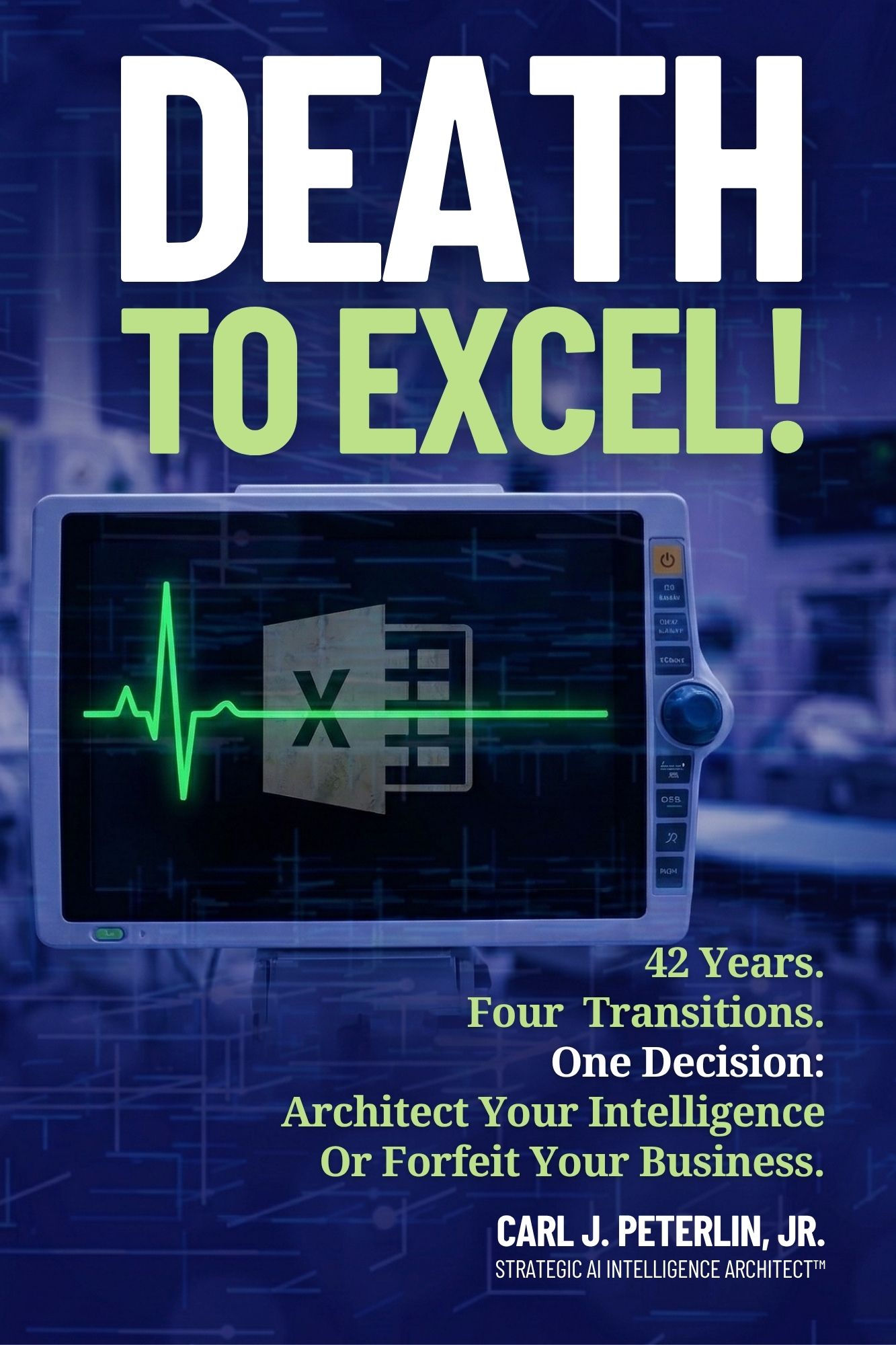
"Stop stealing from yourself." The page where it stops is the one you have not read yet.
Get the Full Book on Amazon →You have seen the number. You have seen the pattern. The cause and the cure sit in one place. Every quarter the spreadsheet keeps deciding what your business is worth, more of that number goes to the competitor who moved first.
Carl J. Peterlin, Jr. · Strategic AI Intelligence Architect™ · 42 years, Fortune 10 to startup